
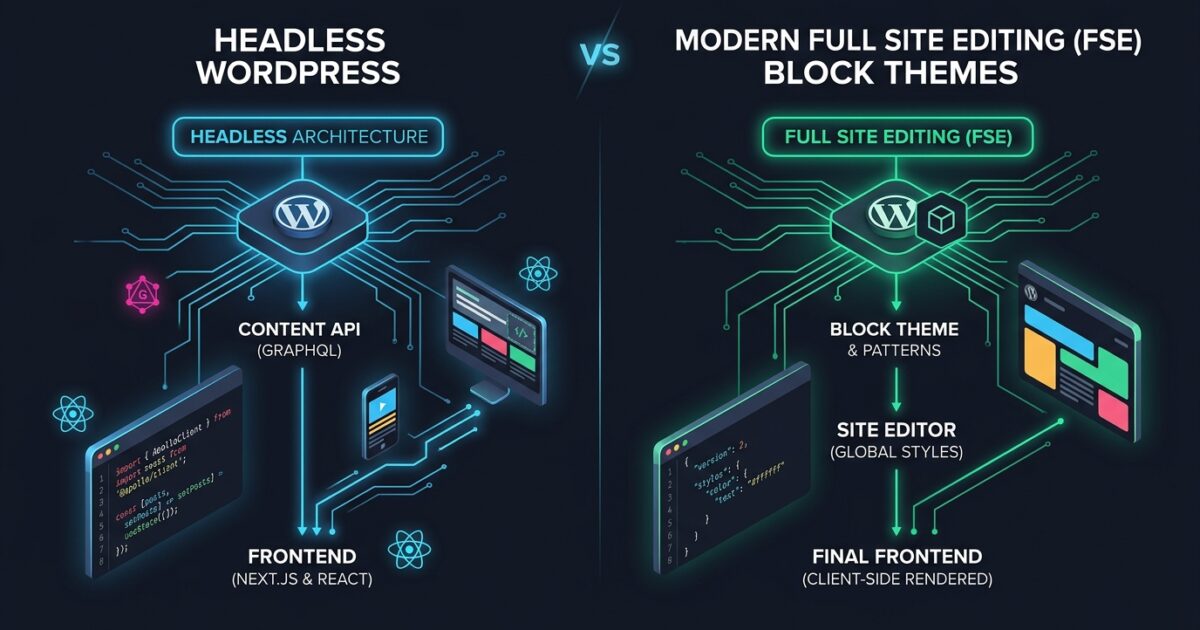
For the past five years, the engineering consensus among enterprise digital teams has heavily tilted toward Headless WordPress—decoupling the CMS backend and serving visitors through Next.js, Remix, or Astro via GraphQL and REST APIs. However, with the maturation of WordPress 6.6+ Full Site Editing (FSE), the Core Interactivity API, and high-performance server-side caching, the architectural trade-offs have dramatically shifted in 2026. Engineering leaders must re-evaluate their stacks to avoid unnecessary complexity and high infrastructure bills.
The Decoupled Dilemma: Why Headless Isn’t Always Better
Decoupled architectures promise complete frontend freedom, sub-millisecond edge routing, and strict security isolation. In early 2020, traditional WordPress themes suffered from jQuery bloat, render-blocking scripts, and excessive DOM trees. Modern Headless setups provided an appealing exit ramp. However, in long-term enterprise production, headless architectures introduce significant operational friction:
- Loss of Native Gutenberg Preview: Real-time visual editing, block transformations, and live WYSIWYG previews require complex custom preview webhooks, token exchanges, and iframe synchronization that frequently break during major React updates.
- Double Infrastructure & Licensing Overhead: Managing both a PHP/MySQL origin server and an edge Node.js hosting tier (e.g., Vercel or Netlify) doubles CI/CD complexity, monitoring surface, and monthly hosting costs ($500+/mo vs $20/mo).
- Plugin Ecosystem Fracture: Standard SEO plugins, form builders, and WooCommerce checkout flows require custom headless rewrites, custom REST controllers, and webhook listeners.
- Cache Invalidation Latency: Content editors publishing urgent breaking news or price changes often experience frustrating 30-to-90 second delays while Incremental Static Regeneration (ISR) or edge caches revalidate.
Real-World Benchmark Matrix (2026 Production Data)
To establish an objective baseline, we benchmarked a 50,000-page content site across both paradigms under identical Cloudflare Enterprise CDN caching conditions and simulated 1,000 concurrent virtual users (k6 load testing):
| Metric / Requirement | Headless (Next.js 15 + WPGraphQL) | Modern FSE (TipWP Pro Block Theme) |
|---|---|---|
| Cached Edge TTFB | 25ms – 45ms | 28ms – 50ms |
| Uncached Origin TTFB | 180ms (SSR GraphQL Fetch + Node.js Parse) | 110ms (PHP 8.3 + Redis Object Cache) |
| Largest Contentful Paint (LCP) | 0.8s – 1.2s | 0.6s – 0.9s |
| Interaction to Next Paint (INP) | 65ms – 140ms (Hydration overhead) | < 35ms (Native Interactivity API) |
| Editorial Live Preview | Custom Preview Bridge required | Native Gutenberg Instant Preview |
| SEO & Schema Agility | Custom Next-SEO hydration & remapping | Native Yoast / RankMath JSON-LD |
| Monthly Infrastructure Cost | $250 – $1,200/mo (Vercel + Origin + GraphQL) | $15 – $40/mo (Any Stabil VPS + Edge CDN) |
When to Choose Headless WordPress
Despite the resurgence of modern block themes, headless remains the undisputed champion in specific multi-platform enterprise topologies:
- Omnichannel Content Distribution: When WordPress acts solely as a central headless CMS delivering structured JSON to iOS/Android native mobile apps, smart TV displays, IoT interfaces, and digital signage alongside the web.
- Strict Enterprise Design System Enforcements: When enterprise frontends must consume unified React/Vue component libraries shared across ten different microservices (e.g., Python, Go, Node.js, and WordPress backends).
- Complex Custom State & Real-time WebSockets: Applications requiring high-frequency socket connections, real-time collaboration canvas tools, financial tickers, or custom WebGL rendering.
When to Choose Modern FSE Block Architecture
For 90% of content-driven websites, SaaS marketing sites, publisher portals, and WooCommerce stores, Modern Block Themes (FSE) offer superior engineering velocity, lower Total Cost of Ownership (TCO), and unmatched editorial freedom:
- Zero Build-Step Interactivity: With the WordPress Core Interactivity API, you get reactive client-side micro-frontends (search drawers, accordion FAQs, cart drawers) directly in vanilla HTML without Webpack or npm build pipelines.
- Instant Dynamic Caching: Full page caching via Nginx/OpenLiteSpeed + Redis object caching delivers near-instant origin responses with zero Node.js memory leaks.
- Single Unified Codebase: No API version desynchronization, no GraphQL schema stitching, and zero stale cache invalidation bugs between GraphQL layers and Next.js ISR.
- Full Native FSE Power: Non-technical marketing and editorial teams can modify headers, footers, bento grids, and landing page patterns without requiring a developer sprint or React component PR.
Architectural Decision Flowchart & Production Guidance
Use this rule-of-thumb decision logic when planning your next enterprise WordPress build:
In conclusion, the era of choosing Headless simply for speed is over. A finely-tuned, modern FSE block theme running PHP 8.3 with Redis object caching and Cloudflare APO matches or exceeds headless performance metrics while drastically slashing technical debt and operating expenses.
Looking to build a lightning-fast FSE website? Explore our TipWP Pro Theme engineered specifically for zero-bloat, 100/100 Core Web Vitals performance.